
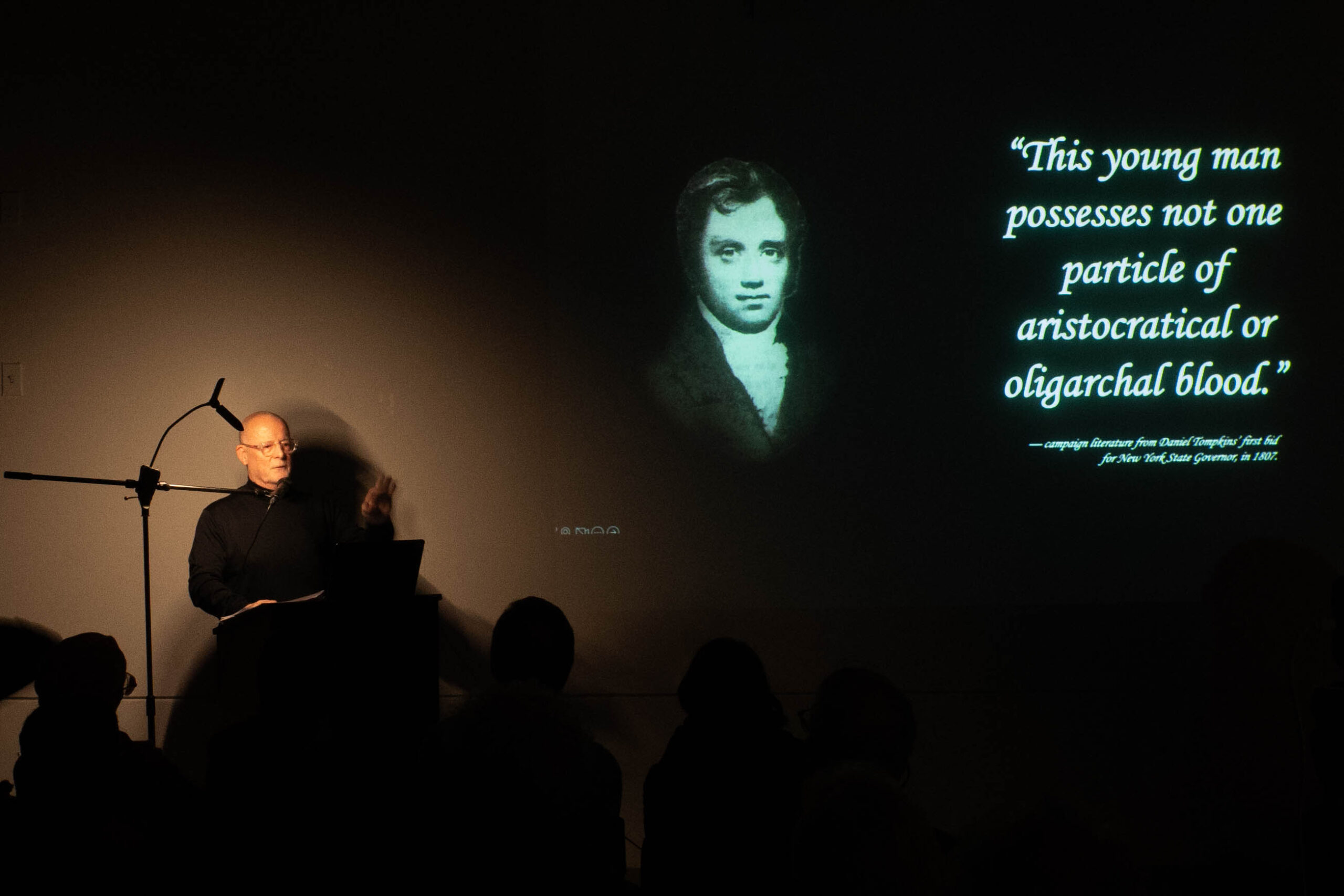
A packed house at the Tompkins Square Library was introduced to the forgotten man of New York City’s earliest days—Daniel D. Tompkins
Story by Robin McMillan; main photo by Paul Gale
Unknown, anonymous, underappreciated. All these words apply to Daniel D. Tompkins—a man whose surname has adorned the compact, iconic East Village park of the same name for almost 200 years, but whose life and legacy have long been doomed to obscurity.
Yet Tompkins was a young, honest, and astonishingly prolific politician whose accomplishments rival many of our nationally recognized figures, yesterday’s and today’s. Consider:
- Tompkins was one of the key figures in the abolishment of slavery in New York State.
- He was Vice-President of the United States twice (each time under President James Monroe). He first held the office while only 42.
- He was only 33 when he was elected New York State Governor—a post he would hold four times.
- During one of those terms, Tompkins saved both New York City and State—and some say the country—in the War of 1812 against Britain.
- At 27, he represented Greenwich Village in State congress in Albany, and at 30 he repped New York City in federal congress in Washington—but he resigned the latter post when appointed the youngest-ever justice on the New York State Supreme Court.
- Tompkins even created the Staten Island Ferry (oh, yes, he did!)
How this packed, rapt room at the Library came to learn about Tompkins is a New York story in itself. It began when yours truly, a native of Scotland but a New York City resident and journalist since 1979, spent a year photographing inside Tompkins Square Park. That resulted in my producing a book titled “Tompkins: New York City’s Biggest Little Public Park.” While primarily a book of photography, it also highlighted the Park’s significant historical episodes.
The Library then invited me to be part of its regular “Author Talks” series. Although 18 of the photographs from the book remain on display in the Library’s main room, the talk never happened. That’s because, at the same time, Senior Librarian Jeff Katz introduced me to Laura Sewell, Executive Director of the East Village Community Coalition. After this meeting, the single Library event morphed instead into a series of four “Friends and Neighbors” presentations and discussions—covering Park history, ecology, music, and community. Tucked in among those was a Park history tour, and that evolved in 2025 into three “Jane’s Walk” Park tours led by Laura and me under the auspices of the New York Municipal Arts Society.
Not done yet! Laura was aware that the 200th anniversary of the abolition of slavery in New York was approaching. My own research revealed that Tompkins had first addressed such a ban in student essays he’d written back in 1793, while a 19-year-old student at Columbia University—he would be Valedictorian, of course—and that he’d ended his final term as New York Governor in 1817 by exhorting both houses in Albany to make the abolishment law. Passed but weeks after Tompkins headed south to become U.S. Vice-President, the act set July 4th, 1827 as the deadline for an outright ban.
Sensing strong community interest in this and Tompkins’ other accomplishments, Laura asked me if an evening could be devoted to Tompkins himself, revealing his entire life, from Westchester farm boy to local hero, to American Vice-President, and then to his final resting place just two blocks west, at St. Mark’s Church-in-the-Bowery on Second Avenue.
The Library was delighted to host. When “The Invisible Man” appeared on its events calendar, the room filled up immediately.
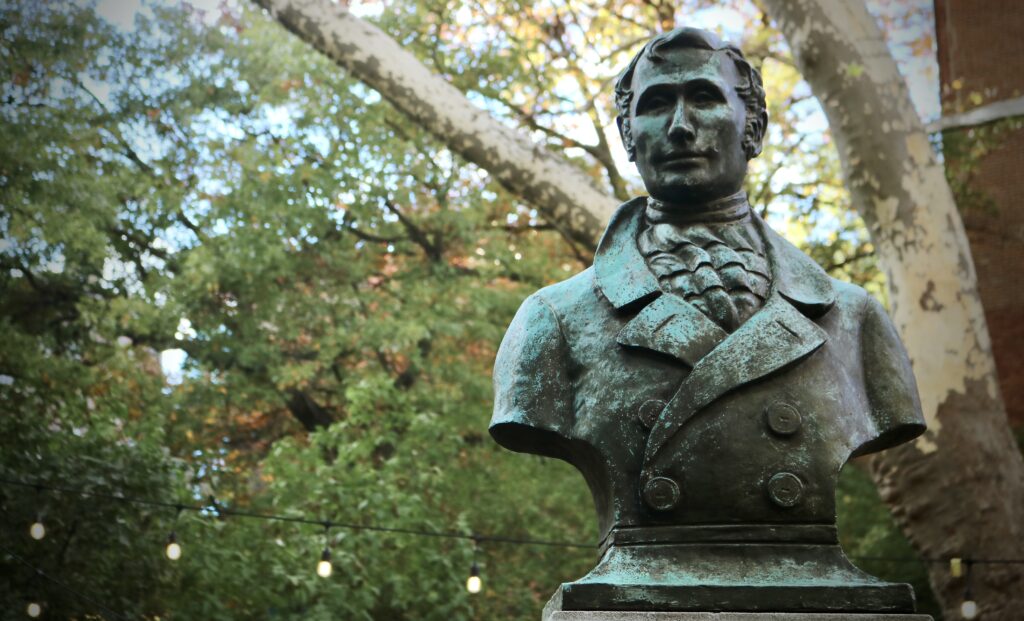
The evening began with a short video of a visit I made to Tompkins’ birthplace, in the Fox Meadow neighborhood of Scarsdale, NY, where Tompkins Road runs along where his rudimentary family farm once stood. I then interspersed short capsule descriptions of the main periods in Tompkins life with three other videos—made in downtown Manhattan; at Ft. Wadsworth, beneath the Verrazano Bridge, and on the Staten Island Ferry. The evening finished with a Q&A that was curtailed only because the library was closing.
The good news is that this 90-minute dive into Tompkins’ story was just the first of several events the EVCC is planning as the 200th Anniversary of abolition approaches. So check back to these pages for further information as all will be revealed about the life and legacy of The Invisible Man.