
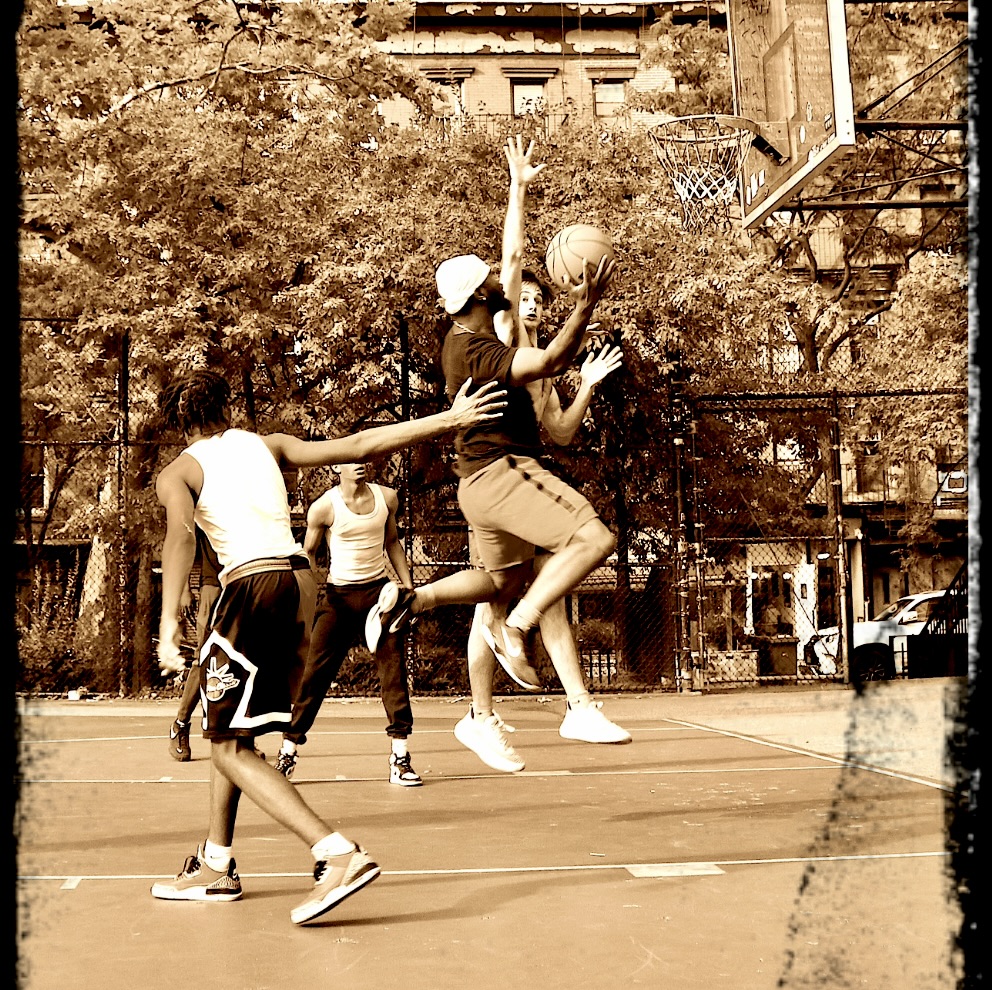
Then or now, the will to win always has been key to Tompkins ball. A veteran of the Tompkins Square Park basketball courts looks back at the ragtag, roughhouse hoops of his youth, and the friends he made along the way
by Brian Rose
photo by Robin McMillan
I was a starter on my high school basketball team in Virginia, where I grew up. We were in the Catholic league, which was where the best basketball in the state was played, probably still is. My skill as a player was appreciated, but was overshadowed by the fact that we had an all-American forward who scored over 30 points a game and went on to play for the University of Missouri.
We played teams from all over the state, but my first exposure to New York basketball was in a tournament in Norfolk, where we were matched up against La Salle Academy from New York’s Lower East Side, at that time the number-one-rated team in the United States. La Salle had John Candelaria, an immensely talented basketball player who was an even better baseball pitcher. Known as the Candy Man, he went on to pitch for the Pittsburgh Pirates as well as the Yankees and the New York Mets. We hung in there, and I scored in double figures, and while we didn’t get blown out, we fell behind early and stayed behind.
In my senior year, I got a couple of letters from D3 schools, but chose instead to go to the University of Virginia to study architecture. I got into some pick-up games with some of the UVA players, and held my own. I played with various college players during the summers back home, but I was really focused on my studies, which shifted from architecture to photography, and that eventually brought me to New York, where I went to Cooper Union.
Once you have played sports at a high level, or modestly high level, it’s hard to get it out of your system, so I was looking for places to play in the city. Living downtown, the most obvious place was “the cage” on 6th Avenue just above West 3rd Street. I don’t think it was called the cage back then, but it was exactly the same set up as now: a small court with out of bounds defined not by the painted lines but by the chain-link fence itself.
Competition was often good, but it was up-and-down, as is often the case in New York street ball. And it was hard to get into games. If you weren’t known by the other players, you’d have to call “next game,” and there usually would be two or three guys who had already called next, none of whom had picked their teams, and none willing to pick you up.
I instead looked elsewhere and ended up playing in Tompkins Square Park. A regular group showed up on weekends and late in the afternoon during the week. The level of play was as good if not better than at the cage, and while the same rules applied for picking teams, things were looser, a little less cliqueish. The physicality of the games was pretty brutal, but fortunately, I had put on some weight, and began to play aggressively the way my high school coach always wanted me to play. It was definitely survival of the fittest out there.
Racially, it was pretty mixed—mostly black, some Latino, and a handful of whites like myself. The black players came to Tompkins from all over the place, not so much from the Lower East Side. I became very friendly with a lot of the players, but never socialized off the court. As basketball players we were, to be frank, the leftovers from high school and college teams—guys who were a little too short, a little too slow, didn’t have great hops, or in some cases were too heavy. There was this one player, a guard, who was barely six feet and had gotten pretty fat. But you could not stop him. He used his weight to protect the ball and plow through defenders, scoring pretty much at will.
One day I was sitting next to him while waiting for the next game, and I asked him if he played in high school or college. He told me he scored 34 points a game in high school. That would have made him one of the best players in the city, for sure.
Another player, Ron (I don’t recall his last name), was always the first chosen when picking up teams. He was not especially tall—about my height—couldn’t jump particularly well, and had only a decent jump shot, but he was a great garbage player. Every loose ball, every rebound, he scarfed it up. And he was a finisher at the hoop. Everything around the basket went in. Today, if I had to put together a street-ball team, I still would pick him first.


Then….and now. The author in his playing days, and now in his working—writing, photographing, book-publishing—days.
Another player, however, had a more refined, more elegant game. One of the best shooters I have ever seen at any level of basketball. “Joe Ski” took a shine to me, and always picked me when choosing a team. His last name was shortened from something Polish, I think. I used to joke with the black players that Joe always picked me because he wanted another white guy on his team. They thought that was pretty funny, and maybe it was even true, not that it mattered on the court. I think it was because I was good at feeding him the ball.
When I wasn’t on his team, I always seemed to end up guarding him. We were both about the same size, and after a while I knew his MO, and stuck to him like glue. He had one basic move, driving to the right, a little hesitation, another step or two, and then going up for a shot.
He was not a Steph Curry kind of shooter with a low quick release, and the cross-over to step-back moves you see today did not really exist then. He went up in the air and cranked the ball behind his head, more Larry Bird like. I’d go up with him, and get all over him—he rarely called a foul—because he knew he would bury the shot anyway. We’re not talking about 15-footers. These were 3-pointers, though there was no line on the court in those days, and we counted baskets by ones.
And he would talk trash. He’d complain, “You fouled me when I made that shot.” I’d tell him to call the damn foul or shut up about it. Or we’d be running back down court after he nailed another 20-footer and he’d say, “Brian, basketball is such a simple game.” Or, if I missed a shot, he’d say, “How come you make everything in practice, but not in the game?” Of course when he took a shot, he’d remind me, it was money in the bank.
I never found out anything about Joe’s personal life. Something one of the other guys said led me to believe that he was looking at a great college career until circumstances intervened. Maybe his girlfriend got pregnant. I recall someone said something about Joe doing the right thing.
I’m really sorry I did not reach out more to these guys. But there was a gap between us. I was an art student/photographer and they all had real jobs, families. Some of them were probably doing okay, others maybe not. Once I was on the street in the neighborhood around Avenue B and 7th Street with an architect who had hired me to photograph a building. As we were talking, a sanitation truck pulled up next to us, and a guy swung off the back of the truck calling out, “Brian, how’s it going!” He removed his glove and we shook hands. It was one of my basketball buddies. My client was impressed, or maybe a little shocked.
We were a ragtag crew, as I was saying, but, despite our shortcomings, we were all athletes far above the average pick-up player you see as you walk around the Lower East Side these days. I remember once, while watching an intense back-and-forth, life-or-death, full-court game, I couldn’t believe I was about to actually go out there. Aside from ex-high school players, there were a few guys who had played pro in Europe, several guys from the former Yugoslavia—very tough players—and occasionally the NYU basketball team would come over and play with us.
One day we were joined by Pat Cummings, the starting center for the New York Knicks. I had him on my team. He was about 6-9, and fortunately one of our biggest guys was there that day to guard him. It was always man-to-man defense, never zone. They battled it out, and I was impressed that our weekend warrior street-baller held his own against someone in top NBA form.
The games in Tompkins attracted some spectators, though nothing like the cage. There was one man in particular, middle-aged as I recall, who hung out regularly. He almost lived in the park, or so it seemed. One day, we heard that he had died. I have no idea the circumstances, though I’m pretty sure it was from natural causes. Whatever it was, it was tragic. Such a constant presence, our biggest basketball fan, suddenly gone. A couple of weeks afterwards there was a memorial for him out on the basketball court. We all stood silently while a poem that he had written was read aloud. It was a brilliantly-written tribute to the magnificence of the great Joe Ski, who was standing there with us. We all just stared blankly ahead, or down at our sneakers, struggling to hold back tears. And then we played another game to 20 by ones. You have to win by two baskets. Sometimes the games seemed like they’d never end.
When not playing basketball in Tompkins Square Park, Brian Rose has had a successful career as both a landscape and architectural photographer, as well as a photography teacher. He also has published several books. The first, with fellow photographer, Edward Fausty, was the classic “Time and Space on the Lower East Side, 1980 + 2010.” His latest, “Last Stop,” a contemporary portrait of New York as seen from the ends of all of the city’s subway lines, will be released this fall.