Thousands of free meals feed thousands of East Villagers each week at Tompkins Square Park (and beyond)
Story by Robin McMillan
The longest lines in New York City today are not for Broadway tickets or sample sales. They’re for hot meals.
There are many reasons for this: food prices; housing costs; (according to the Coalition for the Homeless, the city’s unhoused population is at its highest since the 1930s); government cutbacks (SNAP and WIC food assistance, for instance); government foreign policy; unemployment; medical bills; utility bills, more mouths to feed. Take your pick; none is good.
It’s not a new crisis. There always have been food-insecure people in the community—and their neighbors always have been willing and able to help, be they faith-based, political, or social groups, or just good neighbors pooling their resources. For example, teams from the Interfaith Community Services have been handing out free food in Tompkins Square Park for the past 26 years.
Several developments have changed things in recent years, and not for the better. Generally, there is the growing, yawning gap between rich and poor. Then there was the Covid pandemic, when the institutions that already were helping out the food-insecure closed, or their food suppliers did. At the same time, many in the personal-care and food-service industries who were particularly dependent on customer tips were watching their livelihoods disappear. Specific to the Tompkins Square Park area, there was the sudden influx early in 2024 of hundreds of asylum-seekers who languished at the former St. Brigid’s School on the corner of Avenue B and East 7th St, hoping in the short term for a bed for the night and a hot meal, and in the long term for a permit to work in the U.S. and reconstitute their lives—neither of which was happening fast.
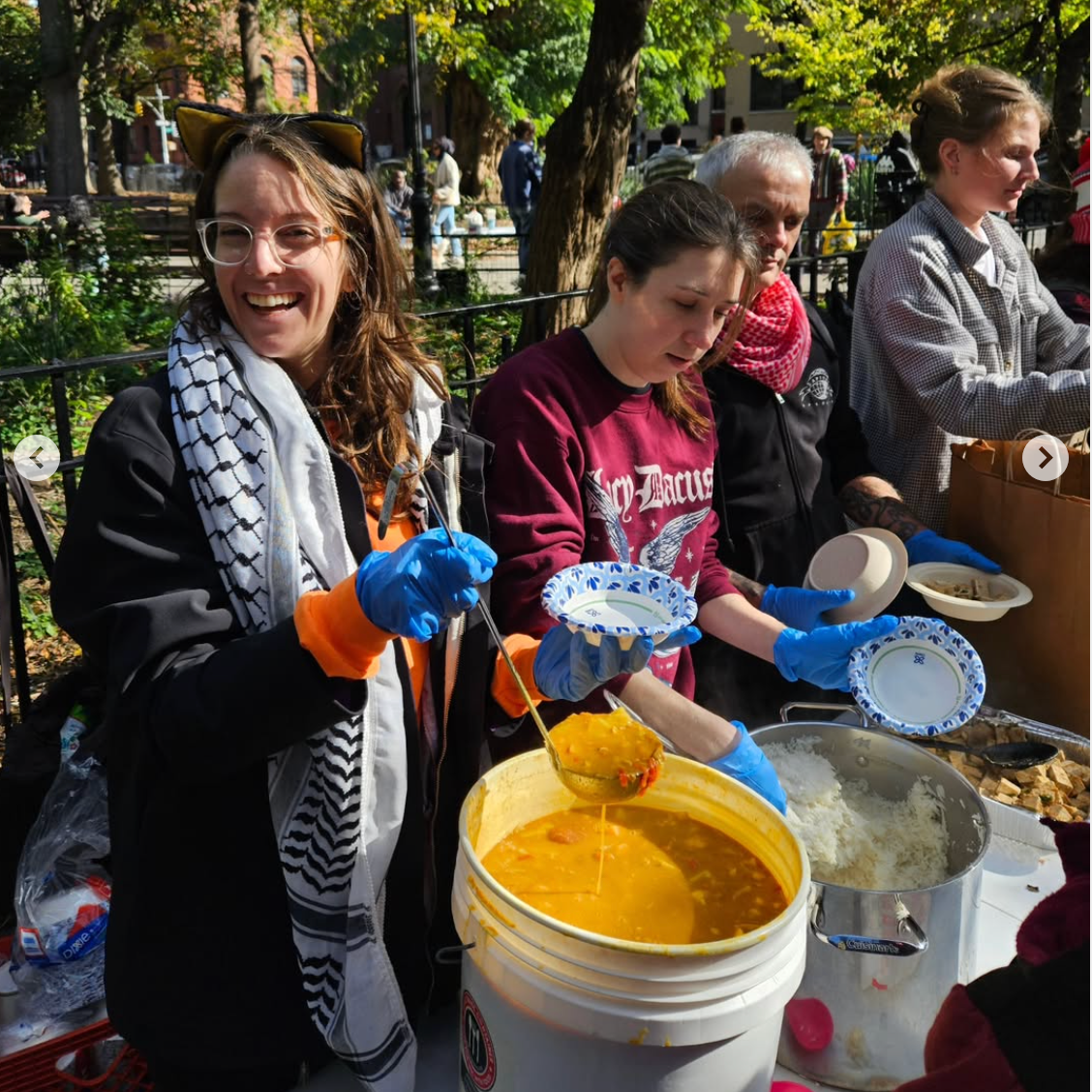
But if there can be a silver lining, it is that the city’s mutual aid network has stepped up to help, and nowhere in New York is this more apparent than in and around Tompkins Square Park. On any given Sunday—on Saturdays and midweek, too, for that matter—at least one group will be somewhere in the park or on the periphery handing out hot meals—in rain or shine, and even in the Arctic blizzards that the city suffered through this winter.
Although each group has its own story and identity, they share similar traits and a common purpose. They are manned by volunteers—many local, but others from all over the Tri-State area—who put their own time, effort, concern, and care into feeding the city’s immense food-insecure population.
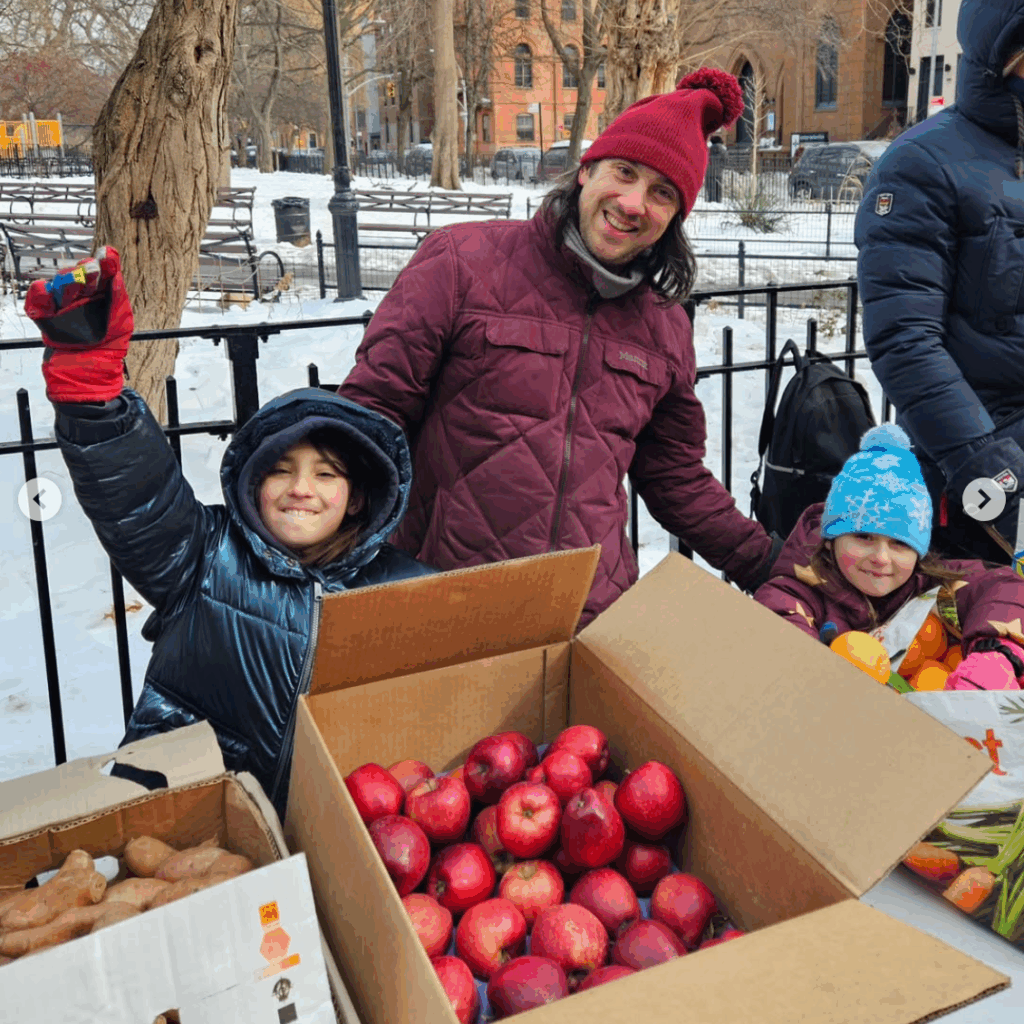
When local and federal governments fail to deliver, as they often do, local food distribution groups do their jobs for them. They have a humanitarian presence, an instinct to protect the vulnerable. Even Saveur magazine, a glossy publication known more for the finer things in food, felt compelled to run an article about the Tompkins-area organizations. “The burden of helping others,” it wrote, “falls squarely on those who practice radical empathy at street level, especially in America’s sanctuary cities.”
During a typical week at Tompkins Square Park, you will find (in chronological order):
- Tompkins Distro—on the corner of 7th and Avenue B on Saturdays, starting at 11 a.m.
- Chilis on Wheels—just inside the Avenue B/9th Street entrance, on Saturdays between 3 p.m. and 5 p.m.
- EVLovesNYC—in the main park area across from the Krishna tree, on Sundays from noon to 2 p.m.
- LES Food Not Bombs—inside the gate on Avenue A and 7th, behind the Cox statue, on Sundays starting at 4:30 p.m.
- In roughly the same spot, the aforementioned Interfaith Community Services hands out meals at 9 a.m. on Mondays, Wednesday, and Fridays.
And note: The groups covered here are just a few examples of the local network. East Village Mutual Aid maintains a complete list, which also includes faith-based and other other nonprofit organizations, with days, places, and times. You’ll find it here: [https://tinyurl.com/EVfreefood]
Show of hands: Who remembers the “No Nukes” concerts at Madison Square Garden in ’79? Bruce, Tom Petty, Jackson Browne, Chaka Khan?
Anyone? Fact is, protest against nuclear power in any form was loudest in the 1970s and ’80s. Anti-nuclear groups formed all over the country. One small group in Cambridge, MA, titled themselves “Food Not Bombs” as they tried to shut down the Seabrook Nuclear power station on the New Hampshire border. They held bake sales to raise money for legal fees, and things took off. Now Food Not Bombs has more than 1,000 chapters—anarchists all—in 60 countries. The Lower East Side chapter has been around for 25 years.
Membership ebbed and flowed in those early days, says LES Food Not Bombs’ Kristine Divney, until the Occupy Wall Street protests of 2011 brought it back. The LES chapter delivered peanut-butter-and-jelly sandwiches to protesters camping in FiDi’s Zucotti Park.
“Then when Covid happened,” Kristine continues, “we had a lot of kids join up. A lot of people had time, and they could apply for unemployment, but they couldn’t meet unless it was outdoors, so we’d get together in Tompkins Square Park and arrange the cooking. Usually that was at a restaurant bar called Down and Out, on East 6th.”
When Down and Out went under, LES Food Not Bombs started cooking at Catholic Worker Joseph House on East 1st St., which has itself been providing shelter and meals since 1967. It was started by Dorothy Day, a journalist, social activist and devout anarchist who also started the Catholic Worker newspaper in 1933. “We still cook there on Sundays,” notes Divney. “and in return we prepare their Sunday meal. We’re both anarchists, so we trade for things instead of buying them.
“We usually have six volunteers, with one person—we call it a ‘bottom line’—in charge of choosing a menu, running things. Then we load the food into a pull cart and walk it up to Tompkins. This winter has not been easy.
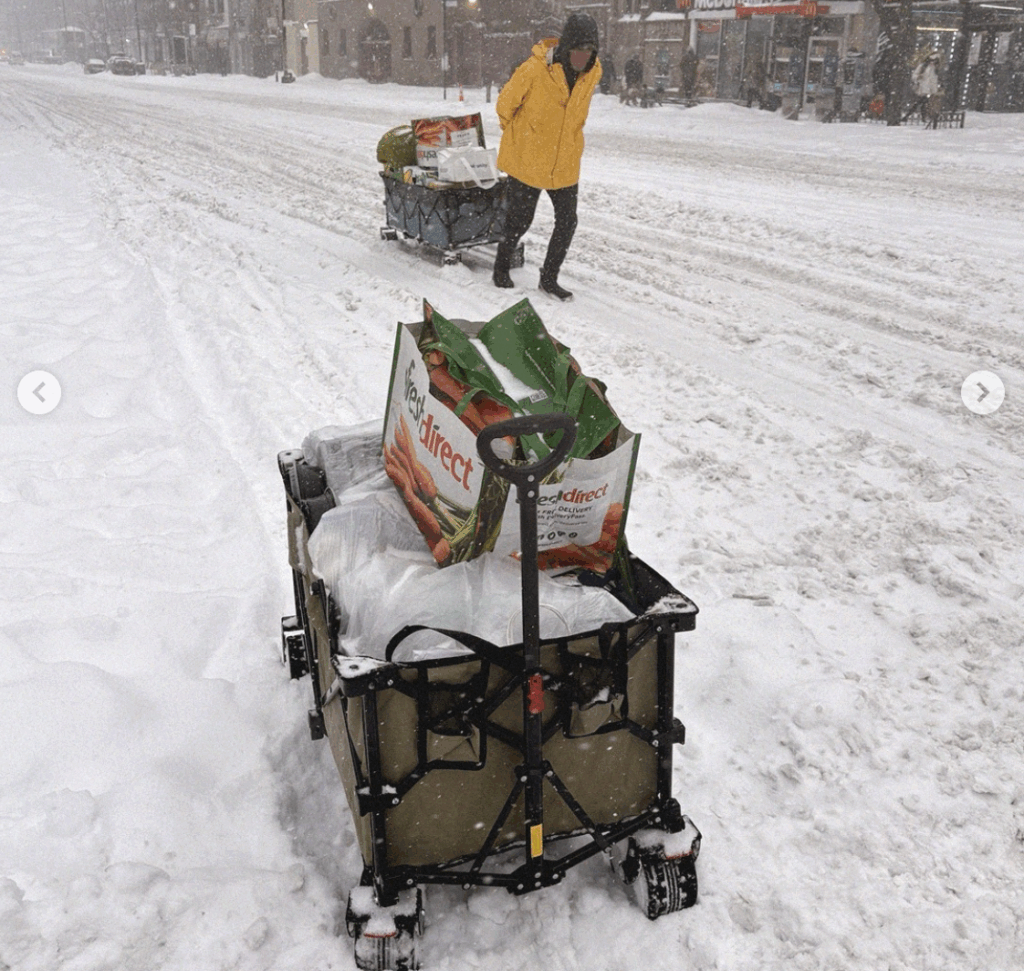
“Once in the park, we also have a parallel effort, with about three volunteers heading to the weekly Sunday greenmarket as it’s winding down, to see what fresh food hasn’t been sold.
“Apart from that, we try to have a main source for our groceries, or we might get a tip about a place going out of business and giving stuff away—and not just food; we also pick up and give out clothes, toiletries, sanitary goods. And we cook for the Anarchist Book Fair held in La Plaza Cultural. Last year we made 400 burritos!
“Then there’s the social aspect. A lot of our volunteers come out also to meet other people—maybe they’re new to the neighborhood and want to make friends. And it’s a good, soft entry point for getting further involved in mutual aid.”
Chilis on Wheels’ involvement has gone from soft entry point to changing the laws of the land. It all began on Thanksgiving Weekend in 2014 when a young lady named Michele Carrera simply wanted to volunteer in a vegan kitchen.
Unable to find a vegan option, she decided to start her own with her assistant Ollie, who just happened to be her four-year-old son. She started by making chili, as it’s plant-based, hearty, and immediately recognizable. It all worked.
Carrera soon would expand her Tompkins handouts to East Harlem, then around 2019 she handed the reins to one of her volunteers, Eloisá Trinidad. That was when things began to change.
Not that Chilis wasn’t busy already. Amid the pandemic, Chilis was delivering up to 2,000 meals a week—as well as groceries. “The pandemic really pulled people together,” Trinidad says now. “We had a very loyal volunteer base, some with cars or vans, and we struck up relationships with farmers markets around the city.”
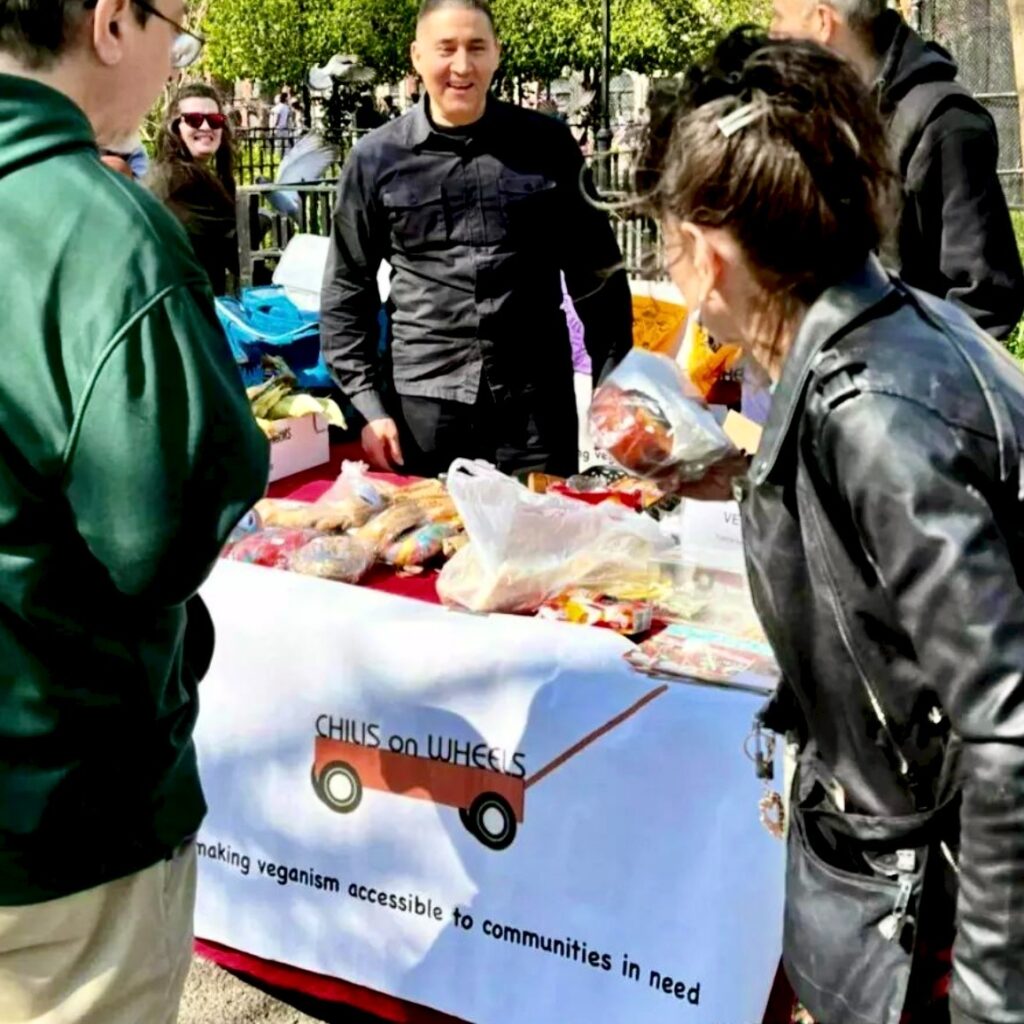
Co-organizer Joe Creaco now heads up the Tompkins distribution, leaving Trinidad (“a born organizer”) to focus on food education and policy. She teaches “low-income vegan education” to community groups, and taught a “Food, Race, and Western Colonization” curriculum virtually to NYC’s The Door youth development program last summer.
As a political activist, she also co-founded the “Plant Powered School Meals Coalition,” a nationwide movement to ensure K-12 students have food options that meet their dietary needs.
“When I took over Chilis,” Trinidad says, “I thought there was a systemic problem. NYC has the largest school district in the nation; it serves about a million meals daily. It is critical that there is proper food access in schools, whether for cultural, religious, personal, or health reasons. Children depend on these meals and often go hungry because of lack of access to appropriate meals.
“Many children, especially in black communities, are lactose intolerant, but it was difficult to get them an option in schools for non-dairy milk. Often a child needed a doctor’s note.”
Not anymore. On January 14th of this year, thanks to Trinidad and her organization, the Federal “Whole Milk for Healthy Kids Act” was signed into law. It allows schools in the entire U.S. to serve “non-dairy beverages that are nutritionally equivalent to fluid milk.”
Mina Mattis’ effort began even more modestly, with an idea and an ask. It was January 2024. “I’d been walking by Tompkins Square Park,” says the founder of Tompkins Distro, “and had seen other people giving out food to homeless people and the asylum seekers who had started gathering at St. Brigid’s, and I’d seen a lot of social media posts saying things like ‘I’m bringing food, clothing, I need a couple of sandwiches.’
“It looked like a lot of people had the same idea, so we started connecting as a community. We decided to do a big MLK Day food drive. I put a post on social media.”
Did she ever. A flier announced the “Martin Luther King Jr. Day Breakfast” and asked for “sandwiches, granola bars, bagels and donuts, hot coffee, fruit, handwarmers, gloves, hats, ponchos, etc.” Her accompanying text read, “At any given moment hundreds of migrants, mostly from Africa and South America, are freezing and starving standing in line for overnight housing assignment and meager, moldy meals provided by the city…on Monday morning we’ll have a single folding table and a couple hundred sandwiches and granola bars. We hope you can bring the rest.”
“And people just started showing up with vans full of stuff,” Mina recalls now. “Like the guy who worked in hotels who showed up with thousands of bottles of shampoos and soaps that his company had to get rid of anyway. So we thought, ‘Maybe we’ll do this again next week.’”
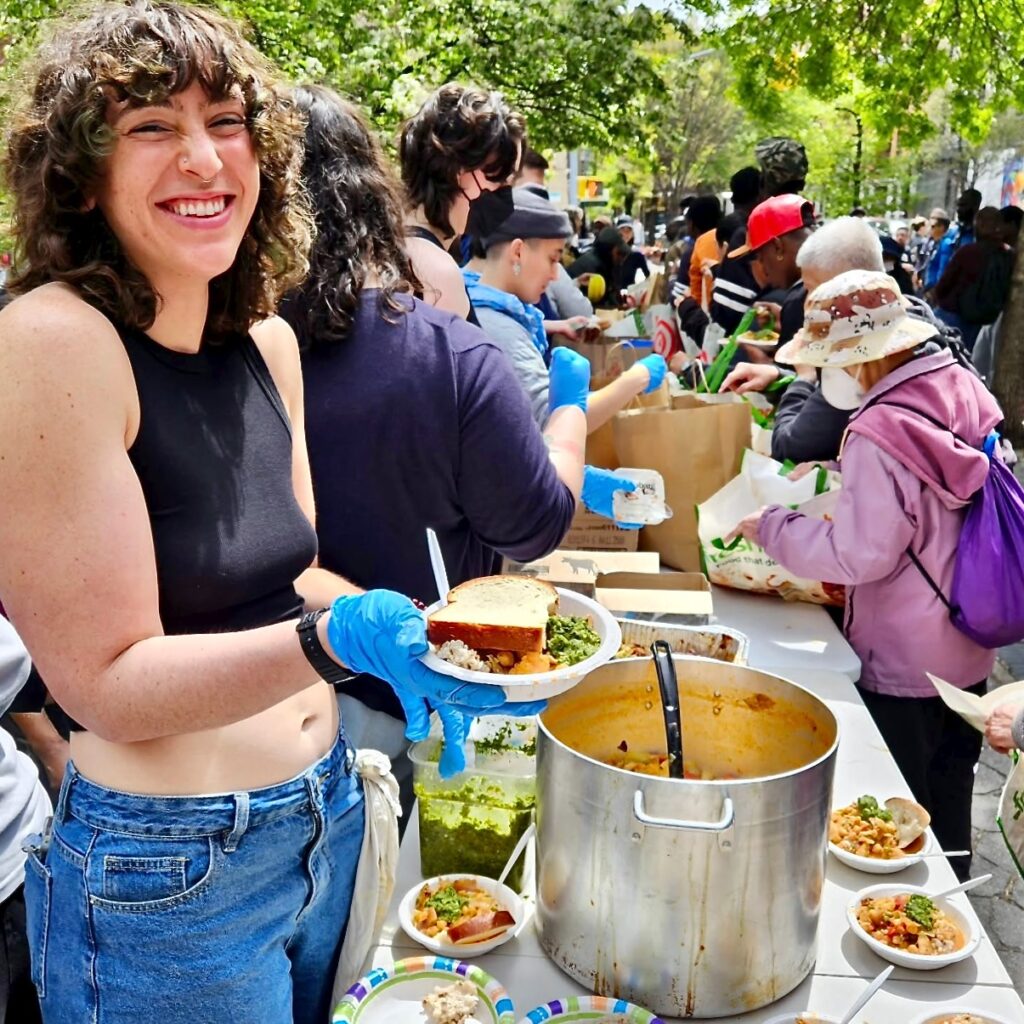
And thus “Tompkins Distro” was born. Soon they were—like a lot of mutual aid groups—cooking in large pots in cramped kitchens in tiny apartments. Everyone was doing it. Some were also finding a home, comfortable with like-minded peers. “A lot of our volunteers are very concerned about human rights,” says Mattis. “and we have a lot of young gay and trans volunteers. They in turn will know others. We have an organizing committee that meets once a week, but anyone can join.”
One of the more intriguing Tompkins Distro partners is “Swamp Dog Hoddle,” a self-described group of “likeminded artists, musicians and creatives based in Flatbush who receive immense joy from cooking for people, hosting, and live music.”
Every Friday night, swamp residents fill several five-gallon drums with the likes of coconut chicken curry or vegetable “balela” (a chickpea salad) and 20 quarts of rice, all to be delivered the following day to the Tompkins Distro tables by the Park.
This January, the Flatbush Swampers joined others from all walks as Tompkins Distro threw a two-year anniversary party, the invitation from Mattis noting, “We definitely weren’t thinking years ahead. but now here we are—1,500 gallons of soup, 15,000+ sandwiches, 25,000+ granola bars, 30,000+ bananas, and (according to the scientists in the group chat) something like 3.5 TONS of white rice later, on the corner [at Tompkins] every single Saturday for two years, rain or shine.”
An ongoing issue with many of the community’s distribution groups is access to kitchens. The veterans usually are stable. A lot of churches come with kitchens, for example. But the independent groups all seem to lead a nomadic life in search of gas burners and prep tables—even for just a few hours.
EVLovesNYC was like this, too, when it began in 2020. Today it has a year-long lease at the Lower Eastside Girls Club, allowing it to expand what has become a citywide distribution network while also training newcomers for a career in restaurants.
Tyler Hefferon explained this to me as he monitored EVLoves’ preparation for Ramadan. On a table beside us sat four large boxes packed with paper bags. In each bag was a bottle of water, small containers of dates and walnuts, a piece of fresh fruit, a granola bar, and a 13-gram stick of “Liquid IV: Hydration Multiplier.” These were “Suhoor To-Go Bags,” to be picked up by anyone in need—such as Muslims in the city’s shelter system—who would be fasting from dawn to sunset. In the course of Ramadan, some 8,000 bags went out.
Elsewhere, EVLoves volunteers were hard at work cleaning huge industrial pots and pans and trays, scrubbing down cooktops. Tyler himself would handle the daily delivery of two bags of lunches—Pesto chicken, vegan chili, pickled cucumber salad—to a nearby ACMH center, which supports the recovery of adults living with mental illness. During the rest of the day groups from around the city would drop by to pick up orders. In fact, EVLoves has become one of the biggest mutual aid food packagers in the entire city, working with 40-50 distributors citywide.
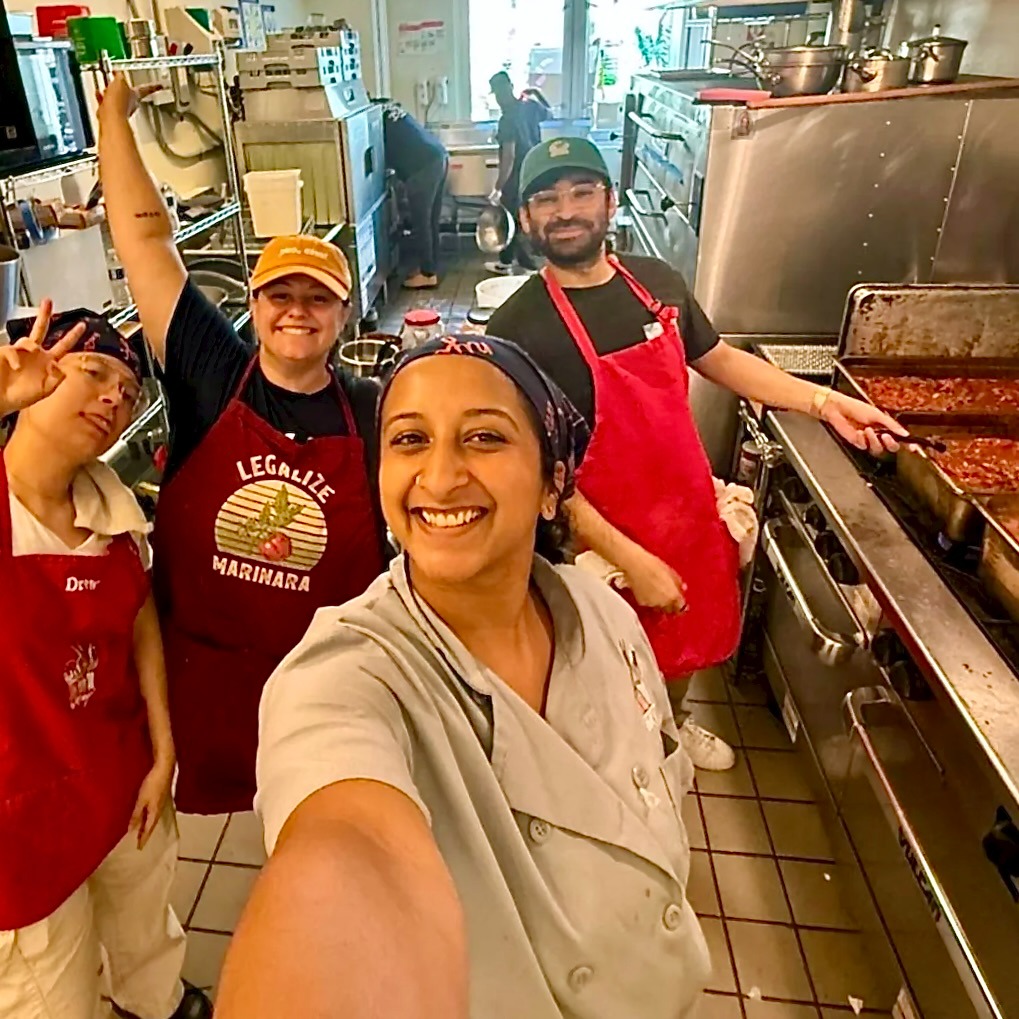
Tyler was recruited originally by a couple of East Village neighbors: Sasha Allenby and Mammad Mahmoodi. In April 2020, they’d been contacted by a church outreach in Elmhurst, Queens, called the Hungry Monk. Covid had just hit the city with lethal force, and Elmhurst was at the epicenter. The leader of the Hungry Monk, a friend known as “Father Mike,” explained that their regular meal providers had shut down, and because of that a lot of people, including Rep. Alexandria Ocasio-Cortez, were contacting him for help.
Sasha, Mammad and Tyler agreed to pitch in, recruited Tyler, and then found a savior on East 7th Street at the C&B Café, whose owner Ali Sahan gave them his kitchen in the evenings, when the Cafe was closed. On their first shift, “EV Loves Queens” as they first called themselves, made 600 meals.
After that, they’d fundraise and pick up food by day, cook by night, then drive the meals to Elmhurst in Mammad’s van, which just happens to be a converted FDNY ambulance. Soon word got out. “There was a lot of social media buzz,” says Tyler. “By June of 2020 we were getting requests from about a dozen organizations around New York. We decided to change our name to EVlovesNYC.”
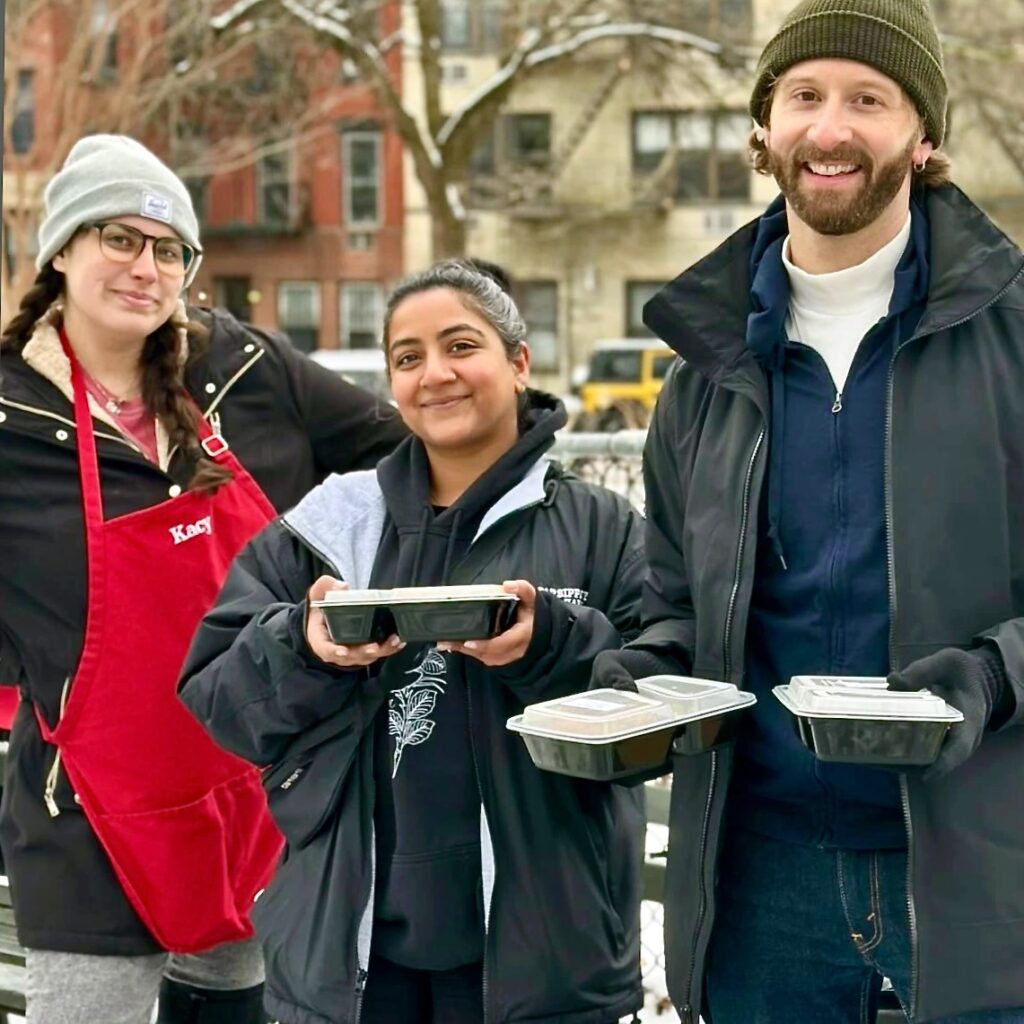
EVLoves is a fine example of how small orders can mount up to something significant. Since it began in April of 2020 EVLoves has served about 750,000 hot meals to food-insecure New Yorkers and nine million pounds of groceries to New York households. Right now it preps about 250,000 hot meals a year.
Sunday is their biggest day, when a team of 40 volunteers will muster up 2,500 meals, including 480 lbs. of chicken, in addition to one meat dish and one veg dish. Seven huge rice cookers will run constantly. It also is the day EVLoves comes to Tompkins Square Park, giving out 288-384 hot meals, depending on the season.
If this number sounds oddly precise, it’s because it is. Tyler came to EVLoves from the financial side of non-profits, including the Democratic Socialists of America, the Lower East Side Coalition Housing Development, and the New Amsterdam School on Avenue B. But before that he worked in various business departments in the restaurant industry, most recently with food hall behemoth Eataly. He has calculated that, all things considered, EVLoves’ prep cost is only $1.07 per meal.
It’s not done yet, however. Tyler outlined the growth plan to Community Board 3 in February, as he sought support for the funding requests EVLoves had sent to New York City Councilman Harvey Epstein and New York State Senator Brian Kavanagh.
This is something of a departure for a mutual aid group. Some are 501(c)3 non-profits, but all crowdfund via social media, perhaps even with a Venmo account for easy giving. Most of the food comes free, either donated by local businesses, farmers markets, or kindly wholesalers. When it comes to food rescues, some businesses contact the distros when they know they have an end-of-day surplus, or if hosting a special event. Most of the distros stay in touch with bigger locations, such as Hunts Point Market, or the Javits Center. All network with tips from sources of their own. One of the Tompkins Distro volunteers, for example, works in the film production and has contacts in the legendary location-shoot Craft Services. EVLoves even rescued unused food from the pro-Palestine tent village protesting at Columbia University in April of 2024. Nothing is off-limits.
But until now, none has sought government grants. “For the first five and half years of our organization,” Tyler told CB3, “we’ve been getting our bearings together in terms of real estate and for commercial kitchen use. But as of February 12, we’re operating out of the Lower Eastside Girls club seven days a week.
“Now we’re capable of preparing about 250,000 hot meals a year. Our volunteers, about 40 people from all over New York, prepare packaged meals commissary style, and we have a couple of dozen distribution partners across the five boroughs who come and pick the food up and take it to where it is needed most.
“Right now we’re cooking between 2,000 and 2,500 meals on Sundays but now we can increase that to around 3,000.”
“On Monday to Friday we have our workforce training program. We have a professional chef leading our culinary training, in six-week cohorts. By the end of the six weeks we hope to have prepared some of these people for their first jobs in the New York restaurant and hospitality industry.
“We’re also looking to invite new demographics into our workforce training program. In the past year or so that [training] was to meet the needs of asylum seekers, who now have received their work authorization. Now we’re expanding that definition to any economically disadvantaged New Yorkers.
“And as our capacity expands we’re looking for new fundraising initiatives, new distribution partners, and new sites that may need regular hot meals, or perhaps just in event of an emergency.
“We now have the capacity to really push our meal production up.”
Spring is here, or close to it. The blizzards are behind us. The distros continue—and continue to grow. They always can use more money, more food, more clothing, more volunteers. But they’re still basically the same: good people who take it upon themselves to help others, as well as each other, at the Park or close to it.